
Share
- Microsoft Teams
Transcript
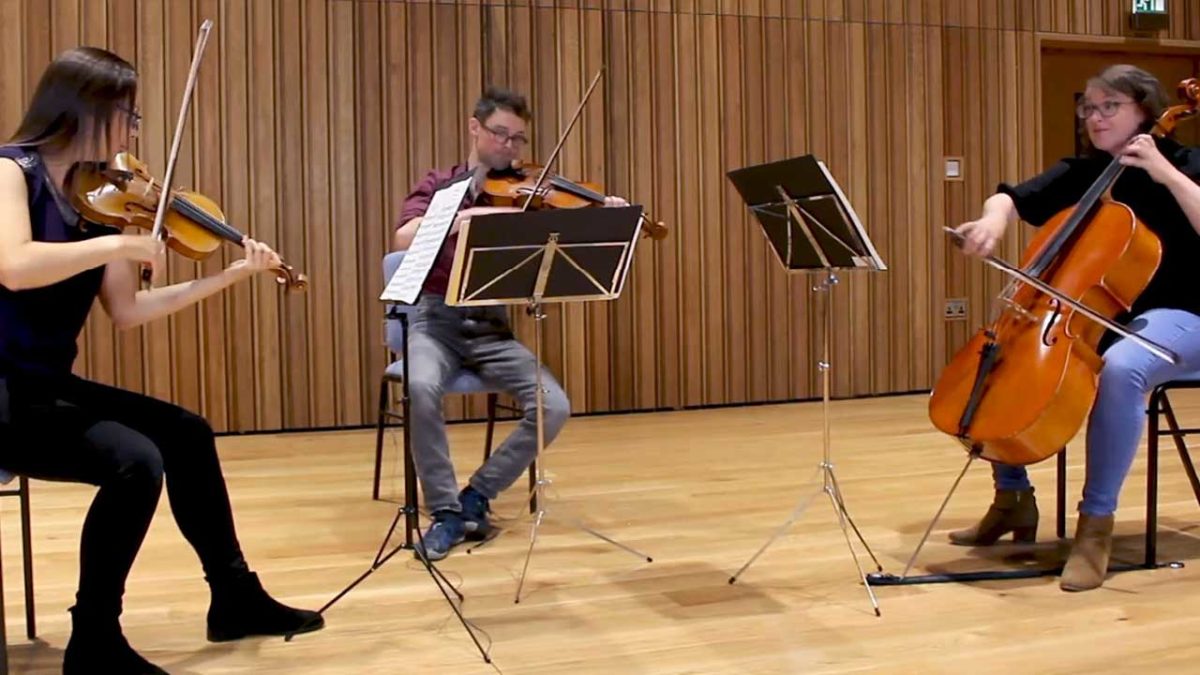
Welcome! We’re going to lift the lid on one of the Berkeley Ensemble’s favorite pieces, Dohnányi’s Serenade for string trio. Now, a string show is music for one violin, one viola and one cello and today we’ve got Sophie playing the violin, Gemma playing the cello and I’m Dan and I’m going to play the viola. We are going to talk about some of the key elements of music as we explore this piece, so let’s revise together.
The piece begins in the style of a march. There are four crotchet beats per bar – we call this 4/4 time – and the speed, or tempo, of the music is fairly fast, certainly fast enough to march to. Another clue is the dotted rhythm that begins the piece: this is really march-like… Remember that rhythm, it’s going to crop up everywhere in this piece.
The first phrase or sentence of music, we hear that rhythm three times, each time separated by a little scale of notes upwards and each time we hear the rhythm, it’s at a higher pitch than the time before. This way of making a tune out of the same idea repeated at a higher or lower pitch than the previous time you heard it is called a sequence and it’s a really good way of making your material as a composer go further. It’s also a really good way of helping your audience to understand and remember your idea, because they get it lots of times in quick succession.
The first phrase is going to be played loudly because this is how Dohnányi asks us to do it: there’s a forte at the beginning of the music. We’ll play it now…
The whole of the first phrase is then repeated straight away, quietly or piano. Dohnányi asks Gemma to play pizzicato, or plucking the strings. This is really helpful to make the overall volume quieter, because doing that is much less loud than using the bow. We’ll listen to Gemma’s very first bar compared with her plucked version…
Those first two phrases, the forte one and the piano one, both finish in exactly the same way, with a trill. Now, a trill is a special kind of ornament, it’s been used in all sorts of places and music over hundreds of years, but most normally like it is here, to signal to listeners that this is the end of a phrase…
After four staccato, or very short and clipped notes, which are played really loudly, fortissimo, the first section of the piece ends piano, or quietly. We know that a new section now starts because completely new ideas are going to be played, but to link everything together, Dohnányi repeats the idea from the very beginning – remember the march rhythm? I get to play it now on a loop: this makes an ostinato…
This ostinato accompanies something completely new, which is first played by Gemma and then afterwards very quickly, by Sophie…
Compared with all the short, excited fragments that make up the first section, this new idea is much longer. We can even call it the first tune or melody of the piece proper. It’s got a very distinctive shape: it starts with an octave, a leap from one G to the next, and then descends slowly, via lots of chromatic notes, or notes outside of the key, that give it extra added colour.
This distinctive shape means that Dohnányi can flip it upside down, or invert it, and the audience will understand straight away exactly what’s happened. Indeed, this is what happens next…
This distinctive tune can even be played like a round or a canon and that’s exactly what Dohnányi does next. It’s almost like he’s a striker showing off before he scores effortlessly. You’ll hear now Sophie starting and Gemma following: a very particular kind of imitation.
To make a satisfying whole, Dohnányi returns to the material from the opening, to make a ternary or ABA form. Unlike a lot of ternary forms, this opening material music, this memory, is really cut, so those scales from the beginning have been reduced from 12 to just three notes…
And that march rhythm from the very beginning makes one last appearance, but here it’s been stretched to twice its length to make a rhythmic augmentation…
For you as listeners, what effect does this have on the character of the piece?
Just when we think the piece is going to end really calmly and quietly, we play a final scale and a chord of C major, our home key. We’re all going to play four notes together, so it’s going to be the loudest thing we do in the whole movement.
Take another listen to the whole piece and see how everything fits together…
Credits
Extracts from Serenade used with kind permission of Josef Weinberger Ltd. Sheet music available from josef-weinberger.com