
Share
- Microsoft Teams
Transcript
Hi there, I’m John and I play the clarinet with the Berkeley Ensemble.
I started the clarinet when I was 10. I really wanted to play the saxophone – I loved the color and the way that it played in jazz music. But I was told that my hands weren’t big enough and I should try the clarinet first. When I got fairly advanced on the clarinet I loved the instrument so much I wasn’t bothered about the saxophone at all. Now I do play the saxophone occasionally but it’s the clarinet that I really love. I love its sound and the role it plays both in orchestra and in chamber music, with a wide range of repertoire. I really like how quiet the clarinet can play and how the sound can start from almost nothing.
I would say the clarinet has a rich, dark, creamy texture, particularly in the lower register, and up high it’s bright and really projects which means it’s often given a solo role. However it can also blend really well with the rest of the woodwind family, and particularly the bassoon which is the other woodwind instrument in the Berkeley Ensemble ensemble. The clarinet’s expressive tone quality makes it the woodwind instrument perhaps most likely to play a big romantic melody in an orchestra. However, the clarinet also can be seen taking center stage in a concert band, a military band, a trad jazz combo or in folk music, and particularly Jewish klezmer music. I really love the variety and diversity that the instrument has.
So like almost all wind instruments you need to blow air through the clarinet to make a sound. The clarinet has a single reed and that’s attached with a ligature to the mouthpiece here. And when air enters into the instrument it sends the air bouncing, reflecting through inside the mouthpiece here. The clarinet is actually a closed pipe so once I’m playing it the air can only go this way, so the little sound waves are bouncing all the way through here and that’s what creates a sound.
So to change notes on the clarinet all you need to do is change the length of the tube with your fingers. Remember a large instrument makes a lower sound and a smaller instrument makes a higher sound. So to play a low note on the clarinet I cover all my fingers here, and I’m going to play the lowest note on the clarinet which is a written E an octave below middle C. There the air is travelling all the way through and coming out at the bell. To make a higher sound I make a shorter tube here and the air comes out of the first open hole just there. This is an E just above middle C, so an octave higher.
We then have an array of other keys which allows us to play all the notes in between. We have a register key on the back which gives us access to higher notes. And then some side keys here which are for trilling and going very fast between notes.
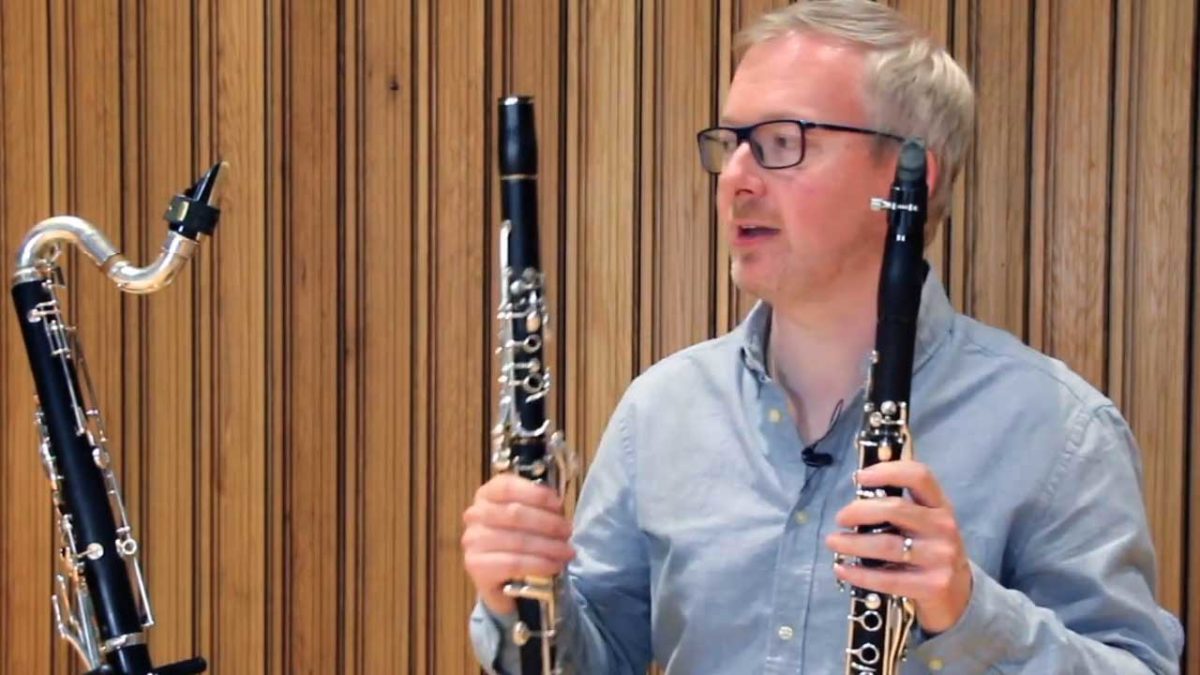
Clarinets come in many shapes and sizes from the highest sopranino instruments to the largest contrabass instruments which can play lower than a double bass. I’ve got a few of the most commonly used ones here today.
The B-flat clarinet is the instrument that you would start off learning on usually, and I should say at this point that the clarinet family is a transposing instrument family which means for the B-flat clarinet when I read a C on the music and I do the fingering for a C what you actually hear is a B-flat.
Now in an orchestra the composer often asks players to use an A clarinet which is just a little bit bigger than the B-flat clarinet, has a slightly different sound and makes some passages easier to play.
The E-flat clarinet is much shorter, much smaller which means it can play much higher. And the sound tends to really carry through a whole symphony orchestra.
And the bass clarinet which takes the lowest note on the clarinet, the E below middle C, and extends down an octave and a third.
Now all these clarinets have so many different characters, composers love to explore them and we have a lot of fun playing them too.
I feel really lucky that my working life as a clarinetist is so varied. I combine performing with teaching at all levels and abilities. I’ve been lucky enough to take performing opportunities around the world and travel to lots of interesting places. My favorite performance is probably playing in Suntory Hall in Tokyo with a large orchestra, an incredible modern hall. But for me what I really love is chamber music because you can get so intimate with fewer players, you can cram into someone’s living room and my most memorable performances have been with the audience one, two meters away. You have that real connection and a really shared experience.
Credits
Musical extract from Michael Berkeley’s Clarinet Quintet, which appears on the Berkeley Ensemble album Winter Fragments, featured here with permission from Oxford University Press and Resonus Classics. Listen to the full track on Spotify, or purchase the album at Resonus Classics.